How Can You Tell If He’s Mister Right or Mister Wrong?
After my divorce, I struggled to trust my judgment. I thought I knew what a good man looked like. My ex-husband provided for us, but I missed key warning signs that led to a painful divorce.
We were young—too young. He was 21, and I was just 18. I believed our marriage would last a lifetime, but back then, there wasn’t easy access to relationship wisdom like there is today. Ironically, now there might be too much advice, and not all of it is right! At that time, I wasn’t walking with the Lord, so I never thought to seek His guidance on choosing a spouse. But now, I know better.
After eight years of praying, I met my husband. I only asked God for two things: that he be a man of God and that he would sing with me in church. God provided both—and so much more. My husband is kind, giving, and has a beautiful heart. We’ve been together for 24 years, and we still laugh at the little things and love each other deeply.
So, how can young men and women discern if someone is the right partner?
LADIES: What the Bible Says About a Godly Man
A godly man should:
Love sacrificially, just as Christ loves His people. (Ephesians 5:25)
Be self-controlled, gentle, responsible, and a strong leader in his home. (1 Timothy 3:2-4)
Love without harshness or resentment toward his wife. (Colossians 3:19)
Be known for integrity and leave a legacy of righteousness. (Proverbs 20:7)
Display the fruits of the Spirit: love, joy, peace, patience, kindness, goodness, faithfulness, gentleness, and self-control. (Galatians 5:22-23)
Most importantly, share your faith and values in Christ.
These traits don’t guarantee a perfect marriage, but they create a solid foundation—especially when both partners are fully committed to the Lord.
GUYS: What the Bible Says About a Godly Woman
A godly woman should:
Be trustworthy, supportive, and bring good into her husband’s life. (Proverbs 31:10-12)
Speak with wisdom and kindness, not harshness or recklessness. (Proverbs 31:26)
Value inner beauty and character over outward appearance. (1 Peter 3:3-4)
Be loving, self-controlled, and have a heart for her home. (Titus 2:3-5)
Strengthen her home rather than causing strife or division. (Proverbs 14:1)
Traits That Apply to Both
A godly spouse will:
✅ Love you as you are.
✅ Be sensitive to your needs.
✅ Spend quality time with you.
✅ Be financially responsible.
✅ Pray with you and for you.
✅ Make your home a safe place.
✅ Celebrate your accomplishments.
✅ Encourage and uplift you.
✅ Respect you always.
✅ Remain faithful to you alone.
Looking back, I wish I had known these things before saying “I do” the first time.
What do you think? Do you agree with this list, or would you add something? Drop your thoughts in the comments below!
Have you ever found yourself wondering how men and women—so fundamentally different in the way they think, feel, and communicate—manage to build lasting relationships? It’s no secret that these differences can sometimes lead to misunderstandings, frustration, and conflict in marriage. But what if, instead of seeing these differences as obstacles, we viewed them as opportunities to grow closer and strengthen our bond? Understanding how our spouse processes emotions, handles stress, and resolves conflict can be the key to transforming tension into teamwork. Let’s take a closer look at what makes us unique and, more importantly, how we can use that knowledge to create a healthier, more harmonious marriage.
Men and women are different and yet sometimes there is overlap depending on the individual. I’m not psychologist, but the differences are stunning which causes me to wonder how they ever got together in the first place.
These are general tendencies influenced by biology, culture, and individual personality. Obviously, there could be overlap from one gender to the other, but highlighting their differences will give us a basis to tackle the question of how to deal with marriage conflict.
Men:
Brain function: Men are focused problem-solving and spatial reasoning
Hormonal Influence: Men are competitive, tend to take risks and are assertive.
Emotional processing: Men compartmentalize emotions more, focusing on solutions rather than discussing feelings in depth.
Communication styles: Men often use more direct, action-oriented communication and may prioritize efficiency over emotional expression
Social and behavioral tendencies: Men are more likely to focus on independence, hierarchy, and status in group dynamics.
Stress response: Men often default to “fight-or-flight,” handling stress with action or withdrawal
Women:
Brain function: Their communication between brain hemispheres is better, potentially leading to stronger multitasking and emotional intelligence.
Hormonal Influence: They tend to bond emotionally, have empathy, and a nurturing spirit.
Emotional processing: They are more attuned to facial expressions and emotional cues, making them more empathetic in social interactions.
Communication styles: Women tend to use more words, show more expressive body language, and seek connection through conversation
Social and behavioral tendencies: Women tend to value relationships and community, often emphasizing cooperation.
Stress response: Women typically engage in a “tend-and-befriend” response, seeking social support
Both men and women can grow by knowing with the generalization are for their gender and that of their partners. So what can each gender do to minimize marital conflict in the first place?
Ask yourself these helpful questions when you are looking for ways to have less conflict in your marriage and become a better spouse:
When you are angry with your spouse or he is angry with you, how do you typically respond?
How do you or your spouse typically resolve conflict? Is it working?
What is one thing about you that needs to change to make conflict resolution better in your marriage?
What is one thing from a scripture that you need to respond to, need to apply in your life/marriage?
Here are a dozen ways to minimize and/or resolve ongoing conflict (some have scripture verses that back up the suggestions):
Agree as a couple that you will work together to resolve conflicts Ephesians 5:21
Go to your spouse only Matthew 18
Deal with the real issue – be specific. When you are angry, do not attack Ephesians 4:26
Look behind the anger to other feelings. Acknowledge your anger to yourself and your spouseDefuse the anger before trying to reach a solution. Be quick to hear and slow to anger James 1:19-20
Be gentle in your answers for it turns away wrath Proverbs 15:1
Do nothing from selfishness Philippians 2:3-4
Clear up issues promptly – don’t let them fester and grow! Ephesians 4:26
Short-term pain is worth long-term gain. Be willing to apologize, ask for forgiveness, and forgive.
Will it be easy? No! But, if you tackle one or two at a time of the above suggestions and master them, you will be further ahead than many couples and will probably be more content as a result.
Do you agree with this list, or do you have other suggestions that worked for you? Comment below.
Navigating the differences between men and women in marriage isn’t about changing who we are—it’s about learning to understand, appreciate, and communicate better with our spouse. Conflict is inevitable, but how we approach it determines whether it drives us apart or brings us closer together. By applying biblical wisdom, practicing patience, and making small but meaningful changes, we can foster a marriage built on respect, love, and unity. The journey isn’t always easy, but the reward—a stronger, more fulfilling relationship—is more than worth the effort. What steps will you take today to create a marriage that not only survives but thrives?
Comment below if you use any of these methods or have something else you’ve done.
The Romance genre never goes out of style, and honestly, I’m not surprised. But what truly caught me off guard recently was a conversation with a woman in the armed services.
She shared how male soldiers on her deployment often asked to borrow her romance novels after she finished them. Surprised? I was too!
When another woman asked if the men ever shared their thoughts, she revealed they not only discussed the books but often teased each other about reading them. I couldn’t help but laugh—it reminded me of how, when I first started writing romance, I kept it a secret. These days? No way!
What struck me most was how these soldiers talked about the characters as though they were real. That small glimpse into their lives made my day, and I made sure to thank her for her service and sacrifices.
Romance Readers: By the Numbers
Recent statistics from the Romance Writers of America (RWA) provide fascinating insights into the readers who fuel this ever-growing genre. Did you know:
Women dominate: 82% of readers are female, while men make up 18%.
Younger audiences are growing: 44% of readers are between 18 and 44.
Diversity: Ethnic groups reading romance include Caucasians, African Americans, Latinos/Hispanics, and Asian/Asian Americans, in that order.
Highly educated, committed readers: 45% have college degrees, and 59% are married or living with a partner.
Geographic hotspots: The Southern and Midwestern U.S. are home to the highest concentrations of romance readers.
Voracious reading habits: 48% read at least one romance novel weekly, while 78% read more than one a month. Personally? I devour two or three a week!
Why Romance?
Romance novels are so much more than escapism. Here’s what they bring to readers:
Hope and comfort in uncertain times
Relatability through familiar emotions and challenges
Empowerment to take charge of one’s own story
Exploration of cultural and social norms
Connection and empathy through characters’ experiences
Stress relief and pure entertainment
Romance resonates universally because it taps into our deepest desires for love, connection, and emotional well-being—all while offering a meaningful and enjoyable experience.
Why Do You Read Romance?
Are you a hopeless romantic, a thrill-seeker, or someone who just loves a happy ending? Do you fit the statistics, or are you breaking the mold? Let me know in the comments—I’d love to hear your story!
Since I’m a contemporary inspirational (Christian) romance author I wanted to research the five stages of dating from a Christian perspective.
Dating is an exciting and significant journey, especially when approached with a Christ-centered mindset. Understanding the five stages of dating can help couples navigate their relationships intentionally and honor God through every step.
The five stages I “googled” did not make sense from a Christian perspective, I finally found ones that made sense.
An initial attraction spurs a glimmer of interest
The first stage of dating begins with attraction. This might be physical, emotional, or spiritual—a spark that piques your curiosity. As Christians, it’s important to evaluate whether this attraction aligns with biblical principles.
1 Samuel 16:7 NKJV tells us, But the Lord said to Samuel, “Do not look at his physical stature, because I have refused him. For the Lord does not see as man sees; for man looks at the outward appearance, but the Lord looks at the heart.”
It’s important to look at the person’s heart as God looks at our hearts. Ask yourself these questions: Does this person share my faith and values? Is their character rooted in Christ? Does he or she lovingly interact with their family?
Lay a strong foundation by building a friendship
Friendship is the cornerstone of any lasting relationship. During this stage, spend time getting to know each other in group settings or casual conversations. Look for compatibility, shared interests, and most importantly, shared faith. Building trust and respect starts here. It is key. Pray for wisdom as you discern if this relationship should move forward.
Proverbs 27:17 tells us “As iron sharpens iron, so a man sharpens the countenance of of his friend.”
Ask yourself these questions: Does this person share my interests and goals? Is he or she easy to talk to? Does his or her faith line up with yours?
Establishing purpose as you date intentionally
Once mutual interest and trust are established, couples enter the intentional dating stage. This is where you move from casual interactions to deeper conversations about life goals, values, and your faith journeys. Be open about your intentions—dating with the purpose of glorifying God and potentially moving toward marriage.
Psalm 37:5 tells us “Commit your way to the Lord; trust also in Him and He shall bring it to pass.”
Pray together and ask godly couples from your church community to mentor you.
Grow in Unity through the deepening of the relationship:
Couples deepen their connection through shared experiences, vulnerability, and trust. It’s a time to evaluate whether you complement one another’s spiritual, emotional, and relational needs. Discuss topics like finances, family, and ministry goals to ensure alignment.
Amos 3:3 tells “Can two walk together unless they are agreed?”
Be alert if disagreements arise. Handle them with grace and seek discernment and guidance from God. Watch for patterns of unresolved conflict or spiritual misalignment. It’s better to cut the relationship before marriage. Many times, important things are overlooked and that can lead to heartache later on. (Speaking from a voice of experience here.)
Engagement, a time for marriage preparation.
Engagement is a joyful and sacred season of preparation. Use this time to deepen your relationship with God and each other. Premarital counseling can provide valuable insights into your strengths and areas to grow as a couple. Stay committed to purity and honor God in your plans.
Psalm 127:1a tells us “Unless the Lord builds the house, they labor in vain who build it;”
Plan your wedding, but also prepare for your marriage—a lifelong covenant.
Finally, dating as a Christian is about more than finding “the one.” It’s about honoring God in your relationships and growing closer to Him through the process. At every stage, pray for wisdom, seek godly counsel, and trust God’s perfect timing.
Which stage of dating do you find most challenging? Share your thoughts below—we’d love to hear from you!
We hadn’t intended to travel to Bamberg, Germany but when we went to Wurzburg, we met two very nice ladies who said Wurzburg had been demolished in the war and most of the beautiful architecture was not ancient but rebuilt to look the same as it had… meaning it wasn’t authentic. We were disappointed but that’s another adventure story. They said to visit Bamberg because it had the historical buildings we adored. We scheduled a trip at a later date to see Bamberg. And we were so glad we did! There just wasn’t enough time to see everything.
There’s a base in Bamberg so we checked it out since our military credentials would allow us to go on base and shop at the base exchange. We were less than impressed after having spent time on the four bases in Stuttgart which were much more impressive.
A cold and cloudy day met us as we made our way to this lovely city. Although it is not on Germany’s famous Romantic Road, personally, I think it should be. It’s picturesque and quaint. Since we got a late start, and it was a little further afield we opted to stay the night and return to our home in Plieningen in the morning.
Unfortunately, we did not plan on staying the night so we had no luggage, toiletries or medication. But we decided to tough it out for one night. We located an IBIS hotel which we thought would be nice because my husband’s sister had stayed in one and she doesn’t stay in any junkie places. While it was “nice” for European standards, it wasn’t what I would call a great hotel. If a micro-hotel is like this, then I’d be claustrophobic. But for one night…what the heck! The bathroom was so small you could barely get to the toilet. And the shower was a tiny triangular shaped thing. The only saving grace was it had a very cool sink! But I worried about getting up in the night and bumping my head against the wall when I got out of bed. There was less than ten inches between the bed and the wall.
After checking into the hotel, we tooled around town on foot. It’s an absolutely lovely city and one I’d like to revisit, but not stay at the IBIS.
We ate at a local restaurant called the Schlenkerla which had a pub-like atmosphere and we sat at a long trestle table with another couple at the other end. It appeared you sat wherever there were seats, and it didn’t matter if you didn’t know the person or not! We had their local specialty: stuffed onions with potatoes. We weren’t disappointed with the fare offered. The building drew us in!
The buildings in the old city were beautiful, especially the old courthouse which was built right in the middle of the river and accessible by two bridges. An amazing feat for the year 1386! Its medieval buildings were authentic and water surrounds the old city with its water canals. It reminds me of Venice. The old town is actually a UNESCO World Heritage Site.
I wished we’d had more time to visit the seven churches on the seven hills surrounding Bamberg, but we didn’t. If you ever get to Bamberg, make plans to stay for at least three or four days to see everything…but don’t stay at an IBIS!
We decided to take a Mediterranean cruise because we were in Europe already and we might never get the chance to go again. Plus, my husband wanted to show me where the Air Force stationed him in Turkey when he was in the military. The three places on the seven-day cruise would be Croatia (Yugoslavia when I traveled to Italy as a girl), Greece, and Turkey. I was excited to go to Turkey and Greece but Croatia? Who goes to Croatia? But it was on the itinerary so what do I know?
We flew to Venice and boarded the ship ready to start the cruise. My husband had never been on a big cruise ship and neither had I. Can I tell you we loved the cruise? My daughter worked for Norwegian Cruise Line at the time and got us a great deal on a balcony room. The cabin was spacious…for a cruise accommodation, that is. Even if the bathroom was not.
I didn’t realize it but Dubrovnik was not a deep-water port so the captain docked the ship a ways away from the port but we could see the port and marina from the ship’s deck. I thought we’d just sail right up to the port and disembark as we did when we got on in Venice. Not so. We’d have to take little boats called “tenders” to the port. I also didn’t realize these boats doubled as lifeboats. The tenders are enclosed and get quite hot for the short trip to shore. I can’t imagine being on that tender that held 150 people if something happened to the ship. Since we had other shore excursions planned, and I wasn’t keen about going to Croatia in the first place, we opted to just hang out in the old city and find things to do until we got back on the ship.
We didn’t have much time to explore because the ship’s personnel told us many times if we missed the last tender, we were on our own to get to the next port. Well, that would not happen given we almost missed the ship when we boarded in Venice.
We tooled around the old town walking through the vast array of alleyways between buildings that led to quaint restaurants with outdoor seating. We looked at the architecture of the square’s many buildings and the churches.
We bought an ice cream cone because the heat of the day was getting to us. Thankfully, the shop person spoke English and we could buy our cones with the euros we brought with us.
The city was lovelier than I expected and reminded me of my beloved Italy. They simply spoke a different language. Today I recommend visiting Croatia because it’s beautiful and the people are very kind and accommodating.
At one point, a bird dropped its load on my arm and thoroughly disgusted me but I had tissues to wipe it off but the tee-shirt was toast for the rest of the trip.
We still had time to kill, so we took a ride on another type of ship ride around the bay. An 18th-century fishing ship! Getting on and off that ship was harrowing not anything like the big cruise ship but then why would it be?
There weren’t many of us on the ship, maybe a dozen or so passengers who were brave enough to board the decrepit-looking ship. The only seats were rough-hewn free-standing benches next to the low walls of the ship.
Once out of the marina the ship sailed around the bay with the masts flapping in the summer wind. When the boat turned it leaned into the water. The edge of the boat was mere inches from taking on water. And while the ride was pleasant, it was also nerve-wracking.
From the sailboat, we could see the summer sun-worshippers didn’t have much sand, but they made the most of what they had. There was one sandy beach, but it was in a cove and it appeared the only way to get to it was by boat. The old city’s massive fortress walls were awe-inspiring. Makes you want to study the history of the city.
I’m glad we went on that sailboat, but I’d more appreciate a new boat next time.
The adventure of the day over, we hopped a tender and returned to the ship.
The first castle my husband and I visited in Germany was Hohenzollern Castle in Hohenzollern, Germany. Where else?
We had been in Germany for less than two months and we were still getting over what my husband’s colleagues called the “German crud”. But it was a Sunday afternoon, and we wanted to do something but we needed to stay close to our apartment in Bonlanden, Fielderstadt (outside of Stuttgart). There were three castles to choose from less than an hour’s drive. We chose Hohenzollern.
I misspelled the name when I entered it in the GPS. Goodness but those German names are hard to spell! I was not yet proficient in spelling the cities and didn’t think I’d ever be proficient. Difficult was an understatement, German was nearly impossible to learn even though English has its roots in the Germanic language!
It was one pm when we arrived and we could see the castle in the distance. It was magnificent. This was the first castle my husband had ever seen. I’d seen a few when I was a teenager and traveled to Italy with my grandparents but this was different. These castles were high on hills in a defensive position and not in the center of a village.
We felt it was in our best interest to take the shuttle to the top of the hill where that majestic castle stood. The trip in that shuttle was a nail-biting horror. The road was narrow, and the shuttle was wide. There were shuttles going back and forth not to mention people who chose not to ride the shuttle walking up to the top of the hill. But the driver was skilled and took the road’s hairpin turns with ease. With a sigh of relief, we got out and walked toward the arched opening that perhaps had been the drawbridge centuries ago. Going through that arched opening led us to a road that had high walls next to it.
What’s exciting is you don’t know how long you’ll have to walk to get to the actual castle and you don’t know how high you’ll have to go. Upward we climbed on the cobblestone “road” walking through various archways. My romantic imagination thought those on horseback may have hidden under those archways waiting for severe rainstorms to subside.
As we walked on we went through another archway. This time, it was a tunnel of sorts. It was May, but that tunnel chilled us. On one side the tunnel had small windows that let a little light in but not much warmth and the other side had small gated cells. I thought they housed the horses but my husband seemed to think that’s where the castle kept their prisoners. Think dungeon and creepy.
We kept moving in a circular fashion until we finally saw sunshine and the castle rose above us. Seeing that huge stone castle made the walk through the cold, creepy tunnel worth it.
The Germans had transformed the gardens on the side of the castle into an area where people could buy a meal and sit outside. There was live music that day, too.
We took the tour of the castle even though we couldn’t understand the tour guide. At least we could see the inside of the castle.
The German castles are exceptional and so well-maintained. It’s a tourist attraction but still, there are many castles in Europe which are not well-maintained. Plus there’s a large army base right there in Stuttgart to bring in even more tourists. Like us.
We ambled along and realized the tour would take a good hour and hoped the tour would end so we didn’t miss the bus. We did not want another escapade like the one we had in Heidelberg. (That’s another story for another time.)
Anyway, we climbed the stairs into the castle. We were the last ones in and the tour guide shut the door behind us with a loud kerthunk.
We walked into an extraordinary room. There were about fifty or sixty people crammed into that small room. We sat on wooden seats attached to the wall. My husband pointed out the tourists were all wearing felt slippers. I didn’t see where or how they got them and since we didn’t understand the language we were at a loss. It’s confounding when you can’t communicate!
I snapped photos of the room (the family tree on the wall) then I noticed the ceiling was all wood and the chandelier had real candles in it. I couldn’t imagine trying to light those things every night, not to mention the fire hazard and being burned. But it was gorgeous.
Buying a tour book in English would have helped us follow along with the tour guide but we didn’t even know where to buy it. The tour guide droned on and on and seemed to describe the castle’s heritage and the family ancestry. The tour guide said something to me but I didn’t understand him and kept shooting photos.
An elderly woman with a cane pointed it at our feet and motioned we should have slippers on. Well, we would have if we had known where to get them. She realized we didn’t speak German, turned and pointed to the room behind us. At that point, we saw the large wooden boxes hidden from our view when we crammed in the ancestry room. I trotted back to the box and pulled two pair out. We weren’t being disrespectful, we just didn’t understand the instructions.
Back in the Dining Hall that same elderly woman turned to us and motioned to the camera and said, “Ist verboten.” We understood she meant taking photos was forbidden inside the castle. Now that bummed me out!
I apologize I don’t have photos of the many rooms we saw but the craftsmanship of the woodwork was extraordinary. The cost to repair or replace any of the woodwork details or the fine furniture and artifacts would be astronomical today. We were told the camera flashes have a negative impact on the tapestries and fabric so that’s why no photos were allowed. I wonder if that’s still the case especially with phone cameras.
We came to a room with a small door. Inside that small room was a small bed (a twin size but very short) and a dressing table with a mirror. I told my husband it must have been the King’s bedroom, but he thought it was the Queen’s bedroom. The tour guide who said he could only speak a little English told us it was the King’s bedroom. I would have thought it would have been more palatial, but it wasn’t. Three or four centuries ago maybe it was palatial. I had to wonder how the lower-class people lived and I shivered.
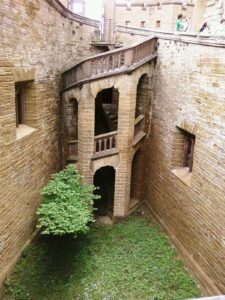
One of my favorite photos of this castle. I loved this circular stairway.
We toured more and more rooms and ended up on an enclosed circular stairway that led outside but the tour guide escorted us back into the castle’s first floor where suits of armor and various kinds of weapons were on display. What struck me was how heavy those suits must have been. How cold in the winter and how hot in the summer? I can’t even imagine it. Perhaps that’s one reason soldiers died young. Who knows?
Gold chalices, silver pieces, and place settings were on display. It’s amazing those priceless pieces have endured all these centuries. But in the final room, we came to a glass case with the King’s crown covered in precious jewels. Magnificent. I asked my husband if he thought the jewels were real. He said he thought so because it was an electronically monitored case.
Once back outside in the courtyard, the band had moved to the outdoor dining hall, and it was curious to hear a Simon & Garfunkel song in such an ancient setting. We had a snack in the courtyard to tide us over before dinner.
While having our snack we noticed the castle had dog bowls with water. The Germans love their dogs and allow them in restaurants and all stores except grocery stores. And those dogs behave themselves, too. I loved the sign above the doggie bowls. It translates to “Doggie Bistro”. Funny.
The wind picked up, and we took the shuttle back to our car and another work week then another adventure in the lovely country of Germany.
When I look back at all the romances I’ve read over the years, it seems to me they have changed. No longer do readers want “just” a romantic movie or book where the central theme is a love story and there’s a satisfying end to the story. Most of the time that means “lives happily ever after”.
No, today’s reader wants something extra. Whether it be the amount of heat, that’s in a book or a movie or something suspenseful, today’s romance has a secondary and sometimes a tertiary plot running through the novel. Then there are sub-genres: paranormal, western, Amish, inspirational, contemporary, historical, young adult, erotic or suspense. A veritable smorgasbord to choose from! And each person who loves a good romance has a different perspective on what they like or don’t like.
These days the category or series romances are popular. Personally, I love them because some of the same beloved characters show up again in another story! Or sometimes it’s the setting where all the stories take place. It doesn’t matter, readers love them.
While researching what surprised me was the number of men who read them. A whopping 18% of all readers are men. The men I know wouldn’t touch them unless they were being forced to as is the case with my husband who gives me feedback on dialogue. Perhaps men who read them are incredibly secure in their own masculinity to do so.
The statistics on the age of readers today were also surprising. I would have thought it would be more baby boomers, but it wasn’t. Very frequent readers were under the age of 34! And only 64% were e-book reader which also surprised me. Personally, I use a service with my iPad mini to read as many as I can in a month for a small monthly fee.
There are other statistics regarding romance readership but these were the most interesting.
Are you surprised by the statistics? What’s your favorite sub-genre of romance?
 We were young—too young. He was 21, and I was just 18. I believed our marriage would last a lifetime, but back then, there wasn’t easy access to relationship wisdom like there is today. Ironically, now there might be too much advice, and not all of it is right! At that time, I wasn’t walking with the Lord, so I never thought to seek His guidance on choosing a spouse. But now, I know better.
 LADIES: What the Bible Says About a Godly Man
 GUYS: What the Bible Says About a Godly Woman
 Men:
 Women:
 Here are a dozen ways to minimize and/or resolve ongoing conflict (some have scripture verses that back up the suggestions):
 Navigating the differences between men and women in marriage isn’t about changing who we are—it’s about learning to understand, appreciate, and communicate better with our spouse. Conflict is inevitable, but how we approach it determines whether it drives us apart or brings us closer together. By applying biblical wisdom, practicing patience, and making small but meaningful changes, we can foster a marriage built on respect, love, and unity. The journey isn’t always easy, but the reward—a stronger, more fulfilling relationship—is more than worth the effort. What steps will you take today to create a marriage that not only survives but thrives?
 She shared how male soldiers on her deployment often asked to borrow her romance novels after she finished them. Surprised? I was too!
 Romance Readers: By the Numbers
 Romance novels are so much more than escapism. Here’s what they bring to readers:
 The first stage of dating begins with attraction. This might be physical, emotional, or spiritual—a spark that piques your curiosity. As Christians, it’s important to evaluate whether this attraction aligns with biblical principles.
 Friendship is the cornerstone of any lasting relationship. During this stage, spend time getting to know each other in group settings or casual conversations. Look for compatibility, shared interests, and most importantly, shared faith. Building trust and respect starts here. It is key. Pray for wisdom as you discern if this relationship should move forward.
 Once mutual interest and trust are established, couples enter the intentional dating stage. This is where you move from casual interactions to deeper conversations about life goals, values, and your faith journeys. Be open about your intentions—dating with the purpose of glorifying God and potentially moving toward marriage.
 Couples deepen their connection through shared experiences, vulnerability, and trust. It’s a time to evaluate whether you complement one another’s spiritual, emotional, and relational needs. Discuss topics like finances, family, and ministry goals to ensure alignment.
 Engagement is a joyful and sacred season of preparation. Use this time to deepen your relationship with God and each other. Premarital counseling can provide valuable insights into your strengths and areas to grow as a couple. Stay committed to purity and honor God in your plans.
 We hadn’t intended to travel to Bamberg, Germany but when we went to Wurzburg, we met two very nice ladies who said Wurzburg had been demolished in the war and most of the beautiful architecture was not ancient but rebuilt to look the same as it had… meaning it wasn’t authentic. We were disappointed but that’s another adventure story. They said to visit Bamberg because it had the historical buildings we adored. We scheduled a trip at a later date to see Bamberg. And we were so glad we did! There just wasn’t enough time to see everything.
 A cold and cloudy day met us as we made our way to this lovely city. Although it is not on Germany’s famous Romantic Road, personally, I think it should be. It’s picturesque and quaint. Since we got a late start, and it was a little further afield we opted to stay the night and return to our home in Plieningen in the morning.
 After checking into the hotel, we tooled around town on foot. It’s an absolutely lovely city and one I’d like to revisit, but not stay at the IBIS.
 I wished we’d had more time to visit the seven churches on the seven hills surrounding Bamberg, but we didn’t. If you ever get to Bamberg, make plans to stay for at least three or four days to see everything…but don’t stay at an IBIS!
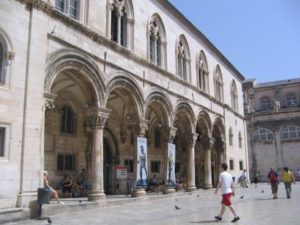 We decided to take a Mediterranean cruise because we were in Europe already and we might never get the chance to go again. Plus, my husband wanted to show me where the Air Force stationed him in Turkey when he was in the military. The three places on the seven-day cruise would be Croatia (Yugoslavia when I traveled to Italy as a girl), Greece, and Turkey. I was excited to go to Turkey and Greece but Croatia? Who goes to Croatia? But it was on the itinerary so what do I know?
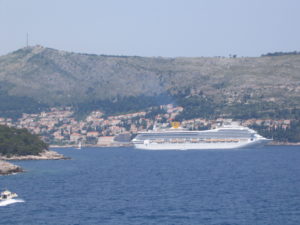 I didn’t realize it but Dubrovnik was not a deep-water port so the captain docked the ship a ways away from the port but we could see the port and marina from the ship’s deck. I thought we’d just sail right up to the port and disembark as we did when we got on in Venice. Not so. We’d have to take little boats called “tenders” to the port. I also didn’t realize these boats doubled as lifeboats. The tenders are enclosed and get quite hot for the short trip to shore. I can’t imagine being on that tender that held 150 people if something happened to the ship. Since we had other shore excursions planned, and I wasn’t keen about going to Croatia in the first place, we opted to just hang out in the old city and find things to do until we got back on the ship.
 We tooled around the old town walking through the vast array of alleyways between buildings that led to quaint restaurants with outdoor seating. We looked at the architecture of the square’s many buildings and the churches.
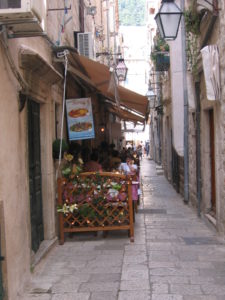 We still had time to kill, so we took a ride on another type of ship ride around the bay. An 18th-century fishing ship! Getting on and off that ship was harrowing not anything like the big cruise ship but then why would it be?
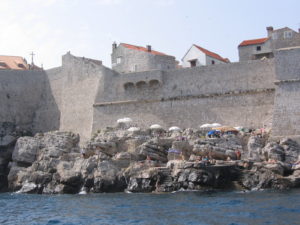 From the sailboat, we could see the summer sun-worshippers didn’t have much sand, but they made the most of what they had. There was one sandy beach, but it was in a cove and it appeared the only way to get to it was by boat. The old city’s massive fortress walls were awe-inspiring. Makes you want to study the history of the city.

 It was one pm when we arrived and we could see the castle in the distance. It was magnificent. This was the first castle my husband had ever seen. I’d seen a few when I was a teenager and traveled to Italy with my grandparents but this was different. These castles were high on hills in a defensive position and not in the center of a village.


 Back in the Dining Hall that same elderly woman turned to us and motioned to the camera and said, “Ist verboten.” We understood she meant taking photos was forbidden inside the castle. Now that bummed me out!
 While having our snack we noticed the castle had dog bowls with water. The Germans love their dogs and allow them in restaurants and all stores except grocery stores. And those dogs behave themselves, too. I loved the sign above the doggie bowls. It translates to “Doggie Bistro”. Funny.

 hese days the category or series romances are popular. Personally, I love them because some of the same beloved characters show up again in another story! Or sometimes it’s the setting where all the stories take place. It doesn’t matter, readers love them.
 The statistics on the age of readers today were also surprising. I would have thought it would be more baby boomers, but it wasn’t. Very frequent readers were under the age of 34! And only 64% were e-book reader which also surprised me. Personally, I use a service with my iPad mini to read as many as I can in a month for a small monthly fee.