 This week marks the holiest week of the Christian calendar. Passion week begins with Palm Sunday and ends with Resurrection Sunday.
Over the years, there have been many films depicting the life and crucifixion of Jesus. Two of the most recent films are Franco Zefferelli’s Jesus of Nazareth, which was originally shown on television during Holy Week in the late 1970s, and more recently Mel Gibson’s The Passion of the Christ.
When I first saw Jesus of Nazareth back in the day, I remember how it deeply affected me. I remember sobbing and thinking how much He must love me (and everyone else) to have gone through such agony.
 And then in 2004, Mel Gibson produced The Passion of the Christ. I remember what a controversy it was. How Hollywood disdained and mocked Mel Gibson and the film. But God will not be mocked, and the film was an incredible success grossing over 612 million worldwide. It became the seventh-highest domestic grossing film and the highest-grossing Christian film of all time.
Standing in line outside the theater, my husband and I knew what we were about to see from our study of the Bible, but we were unprepared for the shock and sorrow on the faces of those who left the theater. And their silence was unnerving.
 We hadn’t expected it would be as brutal as it had been and yet, thinking about the abject cruelty of the Roman Empire, the film was probably not nearly as violent as the reality of the actual crucifixion. When the film ended, there was not only pin-dropping silence in the darkened room, but a stillness, a reverence, that I had never seen in a theater before, or since. As those around us got up and soundlessly left the theater, we had the same sorrow etched on our faces that the previous group had had. When I asked my friends and family members, some in our state and many who lived across the country, of what had occurred when they went to see the film, they recounted the same experience. The unnerving silence, the sorrow, and the stillness.
After the film’s release, Mel Gibson and the film’s star were interviewed and told amazing stories about the film’s concept and things that occurred during the filming of The Passion of the Christ. Most notable and incredible was how the actor, Jim Caviezel, who portrayed Jesus, had been struck by lightning while hanging on the cross and lived. But he had to heart surgery after they completed the film. Caviezel has since visited churches throughout the nation to encourage people to live for Jesus.
 Jesus came to earth as a humble man, died a sinner’s death even though He was without sin and arose from the dead. That is the gospel. And that is what we, as Christians, believe.
But it’s not the end of the story. Jesus will return in glory.
He is not here; for He is risen, as He said. Come, see the place where the Lord lay.
Matthew 28:6
 For almost four hundred years Americans have celebrated Thanksgiving. This year will go down in history as different from all other Thanksgivings in the past century. It is still the fourth Thursday of November as Franklin Delano Roosevelt declared it to be in 1941. We’ll still have Turkey with all the trimmings, pumpkin pie, and the Macy’s Day Parade. But it will be different. Different in a way few of us have seen in our lifetimes.
 In 1620, the Pilgrims proclaimed the Mayflower Compact, which would become the basis for America’s Declaration of Independence. This was a scant year before the first ever Thanksgiving. And if you were in any doubt as to this country’s roots, check out what the Mayflower Compact says. I’ve been out of school for many, many years and didn’t remember it or what it said. But after listening to a Thanksgiving message last night from one of my favorite Bible teachers, Jack Hibbs, I looked it up, and our nation’s colorful history enthralled me.
 Thanksgiving. We have lost sight of what is truly important. What do we have to be thankful for this year? Given all that Americans have suffered and lost, it doesn’t seem like there’s much to be thankful for. And while I understand the need for all the changes to our national holiday this year, I don’t have to like it. Not at all. And yet there are things to be thankful for. Like what you ask.
 Family? Spending time with family will be relegated to telephone calls, FaceTime, Zoom, or any other method we can come up with to see and spend time with family. I am thankful for those methods we have at our fingertips to see and talk to loved ones. That we even have loved ones who we can call is a blessing and a cause to be thankful. Some do not. Yes, I’m exceedingly thankful for my family.
 Provision? In a time where there are nations who are starving, we have an abundance of food in our pantries and freezers. Restaurants who will make your Thanksgiving meal. I’m thankful for a well-prepared meal, even if I have to prepare it myself. It’s not about the turkey and trimmings or having a day off from work (some even have two days off.) It’s about Thanking God for His Provision in our lives.
 So.. we return to the core of why we celebrate Thanksgiving. Opening the door to our hearts will enable us to give thanks for those things in our lives. Search for something in which to give thanks this day, and every day.
 Let’s look at the verse. Obadiah is preaching against the Edomites because they are filled with pride and it has deceived them. They boasted about their natural fortifications in the clefts of the rocks high in the mountains. They thought because their physical habitat was difficult to reach, they were invincible. A sure sign of pride.
 Pride can be an insidious thing. It can manifest itself in anything in a person’s life. You name it, it can be a source of pride. The question is, what is the level of that pride. If the level of pride is so great that it affects our daily life and causes issues, then it’s time to take stock. So, what do we do about it?
 Being aware of how much pride we have is the first step. If you recognize an area in your life where pride has not only taken root but has caused issues, then you are better able to combat it. If you cannot recognize the areas where pride has manifested itself or if that pride is sinful, asking God to show you where those areas are, is the best thing to do. Listening to God speak to you about it, will help you understand what needs to be done. Then ask God to help you exercise better control over it.
 At one time my husband was very prideful in his job. That job and a few subsequent ones were taken away from him. He suffered some years until God showed him it was his pride that caused many of the job losses. It was a challenging lesson for him…and for me. But with God’s help, he recognized it and overcame it.

 and the man, Amos, is one of the minor prophets of the Bible. His name means “burden” or “burden bearer” and he was a man of burden as he delivered prophecies of judgment on the nations surrounding Israel and Israel itself. He lived about ten miles from Jerusalem and Bible scholars have dated his ministry between 750 and 760 BC, at the time of King Uzziah, when the nation of Israel had been divided into two nations for 150 years

 So how does this verse correlate to today’s society?
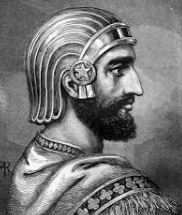 Cyrus was an ancient, cruel and pagan king. It’s interesting to me that this mighty king would proclaim the Jewish God, THE God and then give the Jews the green light to return to Jerusalem and build the temple to their God. This king ultimately allowed the exiled people to return to their homeland.
 Solomon asked God not for wealth, health or abundance of any sort but he asked for wisdom. How wise it was of him to ask God for a trait that he could use to push the nation of Israel to heights no one had ever seen before. God was exceedingly pleased with the request and not only gave Solomon great wisdom, the likes of which this earth hadn’t seen before him or since but great wealth and favor among the nations.
 One day last year my husband called me on the phone from work and said he was having a tough time dealing with a case he had (he’s a network engineer and many times those cases have a complexity that sometimes can be way over not on his head but also his colleagues.) We had prayed that morning, but this was a special prayer for the specifics of the case. We took about five minutes to ask the Lord to intervene and give my husband the “eyes” to see the problem to fix it or have His ministering angels intervene and fix it for him. The wind up was when he got off the phone and went back to work on it, he figured it out, fixed it and the client was happy. We have scores of stories like that. Where God answered the prayer for wisdom. God gives us our needs, not our greeds. We were specific in the wisdom he needed for the moment and God answered that prayer.
 In my younger days, my pastor would sing this blessing at the end of each service. It comforted me. I did not know it was an actual blessing from the Bible. In fact, it is the Aaronic Blessing and one which I have heard both in English and in Hebrew.
 What’s exciting about it is that I’m in an expectant mood to see how He will answer it.
 Most of the time my prayers start out by giving Him glory. I move on to asking for forgiveness because I know I need it every day. I then pray for my family and friends’ needs, then my own needs and finally for global issues. God has been faithful over the years to answer my prayers so I will continue to pray to Him for the needs of my family & friends, church members and worldwide. Sometimes it’s daunting but I know God has called me to be a prayer warrior so that is what I will do.
 Let’s look at the context for the book of Joel and today’s verse. Joel was one of the twelve minor prophets in the Bible. The Bible doesn’t tell us anything more about him other than his father’s name, Pethuel. Sometimes the Bible gives the reader enormous detail about certain things and other times, it does not. If the Bible repeats something many times, it’s important and the reader should note it.
 This wasn’t the only instance in Israel’s history where there were swarms of locusts. In the book of Exodus, we see swarms of locusts when Pharoah would not let the people of Israel leave Egypt. In 1915 a devastating plague of locusts covered what is modern-day Israel and Syria. The first swarms came in March, in clouds so thick they blocked out the sun. The female locusts immediately began to lay eggs, 100 at a time. Witnesses say that in one square yard, there were 65,000 to 75,000 eggs. In a few weeks, they hatched, and the young locusts resembled large ants. They couldn’t fly yet and got along by hopping. They marched along 400 to 600 feet a day, devouring every speck of vegetation along the way. After two more stages of molting, they became adults who could fly—and the devastation continued. And we will see, this same devastation in the time of tribulation in the book of Revelation which mirrors the time of Exodus.
 The middle east is not the only place where locust devastation has occurred. The U.S. had its own devastation back in the 1870s. Here is a link to a great article on U.S. devastation: